
Finite Element Simulation and Analysis

Derecktor Design provides finite element simulation and analysis (FESA) services and can provide a full analysis of structural integrity for any project. 

Understanding FESA

Finite element simulation and analysis is a computational technique for analyzing and predicting the behavior of complex structures and systems under various loading conditions. It uses the finite element method (FEM), a numerical method for solving differential equations governing physical phenomena.

FESA allows engineers to explore different design alternatives, optimize structural performance, predict failure modes, and validate designs before physical prototypes are built. Ultimately, FESA plays a critical role in reducing development costs, improving product quality, and accelerating the design process. 

Saving Time and Money

Through the computational simulation of forces,  Derecktor Design can perform a structural analysis of complex structures without making a prototype. This saves you time and money during both design and fabrication.  

Finite Element Simulation and Analysis Principles

Finite element simulation and analysis follows these principles.
  • Discretization: We divide the structure or system into smaller, interconnected sub-domains to produce finite elements. Importantly, these elements have various shapes, depending on the problem’s geometry and complexity.
  • Mathematical Formulation: For each finite element, we use mathematical equations to represent the material’s behavior and how it responds to applied loads. 
  • Assembly: We use the equations for each finite element in a global system of equations that represents the entire structure or system. This system accounts for the interactions between adjacent elements and boundary conditions.
  • Solution: We solve the global system of equations numerically. The solution uses iterative methods or direct solvers. This obtains the displacements, stresses, strains, temperatures, or other desired quantities at discrete points within the structure.
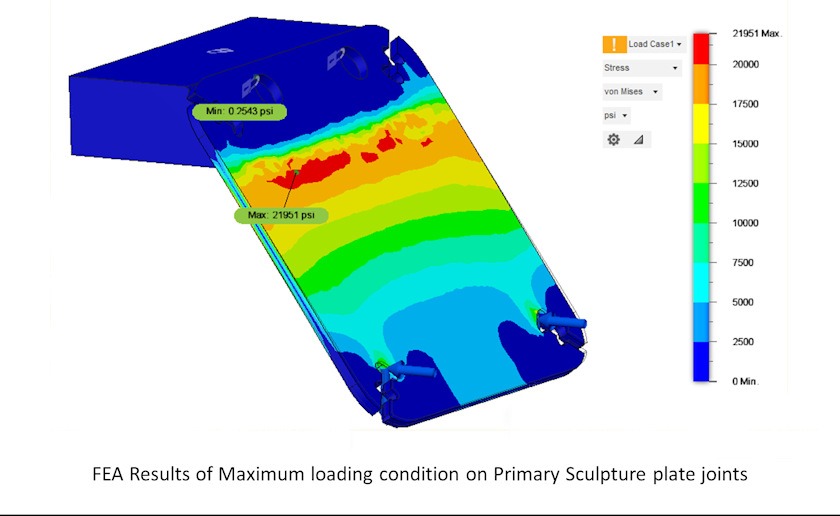
  • Post-processing: Once the solution is obtained, we use post-processing techniques to visualize and analyze the results. Then we generate graphical representations to interpret the behavior of the structure under different loading scenarios.
Contact us about FESA.
Failure Effect Analysis results for sculpture plate joint loading

Finite Element Simulation and Analysis

Reduce costs, improve quality, and accelerate the design process.

Explore different design alternatives, optimize structural performance, predict failure modes, and validate designs before physical prototypes are built.